Newsletter Subscribe
Enter your email address below and subscribe to our newsletter
Enter your email address below and subscribe to our newsletter

 Byadmin
Farming margins are thin. Water costs are climbing. Every hailstorm or drought year reminds farmers how little control they have over their income.
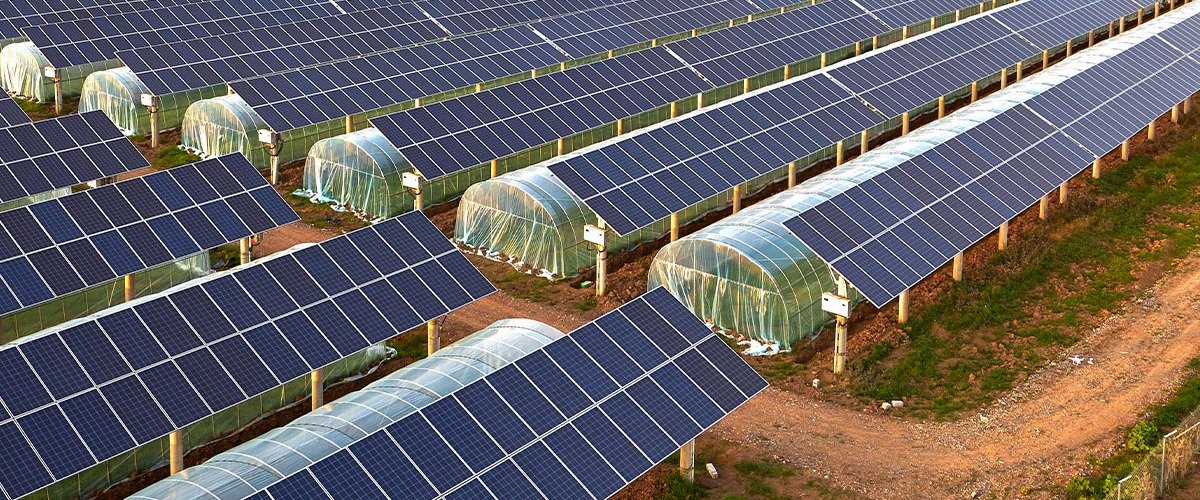
Agrivoltaics changes that calculation. You put solar panels above cropland, crops grow underneath, electricity gets generated above, and the same piece of land earns money twice. Commercial projects across four continents have been proving this out for nearly a decade.
The concept was first described in the early 1980s by researchers Armin Goetzberger and Adolf Zastrow. Commercial deployment picked up through the 2010s, and today agrivoltaics installations span Germany, Japan, France, India, and the US.
Farmers running Agri-PV systems earn from two sources simultaneously: crops and solar power. Depending on location, system size, and leasing terms, agrivoltaics can add $500 to $2,000 per acre per year in electricity revenue on top of existing farm income. That revenue doesn’t depend on commodity prices or rain.
The panels also change how crops grow. Partial shading cuts soil evaporation. Research from Chad Higgins and colleagues at Oregon State University found that certain crops under solar canopies needed substantially less irrigation while maintaining yields comparable to open-field production. For farmers in water-stressed regions, that matters more than the energy income.
A less-discussed practical benefit: physical protection. Panels block hail, reduce rain impact, and cut radiant heat during heat waves. Farmers in hail-prone areas have reported real drops in crop damage after going agrivoltaic.
The longest-running rigorous agrivoltaics trial in Europe started in 2016 at Heggelbach farm in Baden-Württemberg. Fraunhofer ISE led the project, installing a 194 kWp bifacial solar array above fields growing winter wheat, potatoes, celeriac, and clover grass.
The key metric was the Land Equivalent Ratio (LER). The Heggelbach project hit an LER of 1.56, meaning you’d need 56% more land to produce the same total output of food and electricity separately. One plot was doing the work of 1.56.
Winter wheat yield fell by just 5.3%. Celeriac, which typically struggles under direct summer heat in the region, showed no meaningful yield loss under shade. Fraunhofer ISE researchers published the findings in Solar Energy journal, and German policymakers used the data directly when writing agrivoltaics provisions into the country’s Renewable Energy Sources Act.
Jack’s Solar Garden in Longmont, Colorado, became one of the most closely tracked agrivoltaics sites in North America after its 1.2 MW array went up across roughly five acres. The National Renewable Energy Laboratory and Colorado State University both partnered with the farm to measure energy output, crop performance, soil health, and pollinator activity at the same time.
Tomatoes, squash, and leafy greens all grew successfully alongside and beneath the panels. Pollinator habitat planted between panel rows showed measurable increases in bee activity, which has indirect benefits for crop pollination on the farm and neighbouring properties.
The installation produces enough electricity to power hundreds of homes annually while the farm continues producing food. The site also functions as a public research and education facility, which turns it into a reference point in US agrivoltaics policy conversations at both state and federal levels.
Dedicated agrivoltaics conferences now bring farmers, project developers, utilities, banks, and policymakers into the same room. Five years ago, the agrivoltaics conference agenda was mostly feasibility data and academic papers. Today the questions are operational.
How do you structure a land lease when the farmer stays on the land? Which crop mix works in a continental climate versus a Mediterranean one? What does a lender need to see before financing a 10-acre Agri-PV project?
The shift in who’s asking those questions tells you where the sector is. They’re not researchers anymore. It’s farmers, developers, and the people writing the checks.
See Also: Why London Professionals Are Switching to Private Hire for Airport Journeys
Q1: Does shading from solar panels hurt crop yields?
It depends on the crop. Leafy greens, herbs, root vegetables, and berries tolerate or benefit from partial shade. Shade-sensitive crops like corn are not compatible with most agrivoltaics setups. Panel height, spacing, and orientation should match the crop mix from the start.
Q2: How much land does an agrivoltaics project require?
Commercial installations typically start at one to two acres. Ideal scale depends on local solar irradiance, crop choice, and whether the priority is energy generation or food production.
Q3: How are agrivoltaics projects typically financed?
Most combine a land lease agreement, a solar Power Purchase Agreement, and, where available, renewable energy or agricultural subsidies. Farmers usually don’t own the panels. Leasing land to a developer while keeping farming rights is the standard structure.
Q4: Which crops perform best in Agri-PV systems?
The research supports potatoes, lettuce, basil, clover, kale, carrots, and various berries. In French and Swiss research, grapes performed well under partial shade, with documented reductions in sunburn damage and drought stress during summer heat events.
Q5: Are agrivoltaics systems eligible for government incentives?
Yes, in several markets. Germany’s Renewable Energy Sources Act includes agrivoltaics-specific provisions. In the US, the Inflation Reduction Act’s investment tax credits apply to the solar components. USDA grants have also funded agrivoltaics research and demonstration projects.