
A bookcase often starts life as a solution to one problem: books piled on the floor, papers taking over a desk or keepsakes with nowhere sensible to go. Yet it soon becomes part of the room’s architecture. Its height changes the feel of a wall, its finish affects the colour scheme and its shelves can look either reassuringly ordered or permanently overfilled. Buying well therefore involves more than counting how many books you own. The right piece should accommodate what you need today, allow for a little change and remain practical to live with. Before comparing finishes and fashionable shapes, it helps to look carefully at the room, the collection and the way both are used.
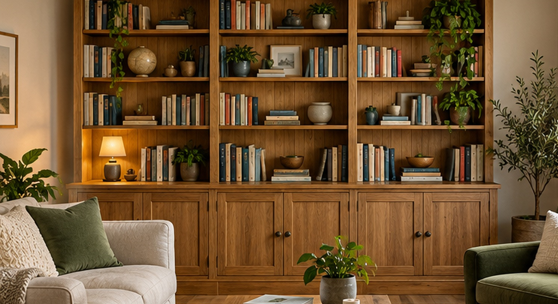
ILLUSTRATIVE IMAGE | Book storage works best when it supports the room, rather than dominating it.
Start With the Wall, Not the Catalogue
Measure the usable wall width, floor-to-ceiling height and depth available in the room. Then note the less obvious obstructions: skirting boards, radiators, sockets, light switches, door swings and window handles. A bookcase that fits the measurements on paper may still interrupt a walking route or sit awkwardly against a deep skirting board. If it needs assembling on the floor, check the clearance required to raise it upright. Tall units can require more headroom during assembly than their finished height suggests.
Think about how the room is experienced from its doorway. In a narrow sitting room, a shallow unit may preserve the sense of space better than a deep cabinet, even if it holds slightly less. Around a home-office desk, you will also want easy access to files without pushing your chair backwards into furniture. Mark the proposed footprint with masking tape, and walk past it several times. That simple exercise exposes compromises which measurements alone can miss.
See also: Enhance Your Beauty with Luxury Burmese Hair Collection
Design Shelves Around What They Will Actually Hold
A shelf full of paperback novels presents a different challenge from one carrying large art books, ring binders or heavy reference volumes. Measure your tallest items and the width of your widest books. Adjustable shelving offers flexibility, but check how closely the shelf positions can be set. A broad shelf left with a large unused gap above ordinary books wastes valuable storage; a very tight opening makes items frustrating to remove. Reserve a few taller spaces for folders, framed photographs and objects that need breathing room.
Depth matters as much as height. Most everyday books do not require exceptionally deep shelves, while oversized albums and storage baskets may. A mixture of open display and concealed compartments often works better in a shared living room than completely open shelving. Keep frequently used books between roughly waist and eye level, place less-used pieces higher and avoid loading the very top with objects that are difficult to reach safely.
Understand What the Materials and Joints Offer
Solid timber, veneered boards and engineered wood can all make useful bookcases, but they behave differently. Timber has natural grain variation and can be repaired or refinished in some circumstances; it also responds to changes in humidity. Quality veneer offers a wood appearance over a stable core, while laminated surfaces may be practical where wiping clean is a priority. The label alone does not reveal build quality. Inspect the shelf thickness, the way uprights meet the base and the strength of the back panel.
For readers comparing a solid wood bookcase with other constructions, it is worth reviewing a wider set of buying considerations before settling on a material. Look for secure, well-aligned joints and sensible shelf spans. An excessively long unsupported shelf is more likely to bow under concentrated weight. If your collection is particularly heavy, divide it across shorter shelves and place the heaviest volumes low down to keep the unit more stable.
Let the Bookcase Belong to the Room
A bookcase should relate to the furniture surrounding it without necessarily matching every finish. Pale oak tones can bring warmth to white walls; painted shelves can recede visually when their colour is close to the wall; darker timber may create a useful focal point in an otherwise light interior. Pay attention to the silhouette as well as the colour. Open-sided shelving appears lighter, while a solid frame with a plinth can suit an older room with substantial joinery.
When styling, resist filling every centimetre. Group books in practical categories and allow occasional gaps for a small lamp, framed artwork or a ceramic object. The goal is not a showroom arrangement that takes an hour to maintain. It is a rhythm that makes the contents readable and easy to retrieve. Repeating a couple of colours or textures helps the display feel connected without requiring identical accessories on every shelf.
Plan for Safety, Cleaning and Changes of Mind
Tall furniture should be secured with suitable anti-tip fixings, following the manufacturer’s guidance and taking the wall construction into account. This is especially important in households with children or pets. Check that shelves are correctly seated and respect stated load limits where supplied. Uneven floors can make a tall unit wobble, so deal with levelling before filling it. Keeping heavier items low improves everyday handling, although it is not a substitute for appropriate anchoring.
For maintenance, dust shelves with a soft cloth and follow the finish-specific care instructions. Avoid leaving damp pots directly on timber, and position sensitive wood away from repeated splashes or strong heat. A bookcase is also easier to live with when you leave a little spare room for new books and changing needs. Reassess the arrangement once or twice a year rather than allowing overflow to dictate its appearance.
Choose for the Next Few Years, Not Just This Weekend
The most successful bookcase is the one that passes three tests: it fits the room comfortably, supports the weight and dimensions of what you own, and makes sense alongside your everyday habits. Measure carefully, examine construction rather than relying on material names and choose a layout you can adjust. Good storage should make a room feel calmer, not demand attention every time you walk into it.