Newsletter Subscribe
Enter your email address below and subscribe to our newsletter
Enter your email address below and subscribe to our newsletter

 ByJohn A
A modern room can be beautifully organised and still feel detached from the world outside it. Smooth cabinetry, straight lines, concealed storage, and a controlled palette create order, but too much visual uniformity can make a home feel sealed off from weather, landscape, and the passage of time. Coastal art offers a way to restore that connection without adding clutter. A photograph of a headland, a painting of tidal water, or a quiet stretch of sand brings natural forms into the room while leaving the architecture intact.
The key is to think beyond the familiar image of a bright beach. Nature is not always blue water and sunshine. A coast can be dark rock, sea mist, pale dune grass, rough water, or the long shadow cast by a cliff. Those details create a more nuanced relationship with the landscape because they reflect the coast as a changing environment rather than a fixed holiday mood. A grey seascape may sit comfortably with concrete and charcoal upholstery; a warm dune image can soften a room dominated by white walls and black steel. The artwork works best when it introduces a quality the room needs, not simply a subject that matches its label.
Interior designers often describe coastal rooms through natural light, understated colour, and tactile materials. Architectural Digest’s overview of coastal design points to linen, wood, jute, and rattan alongside soft neutrals and clean lines, while warning against overly literal nautical decoration. That is a useful distinction: a room does not need shells, anchors, or rope to feel connected to the sea. It can use a shoreline image as the visual reference, then let texture and light carry the rest. The article [Coastal Interior Design: Everything You Need to Know](https://www.architecturaldigest.com/story/coastal-interior-design-101) offers a helpful account of this quieter approach.
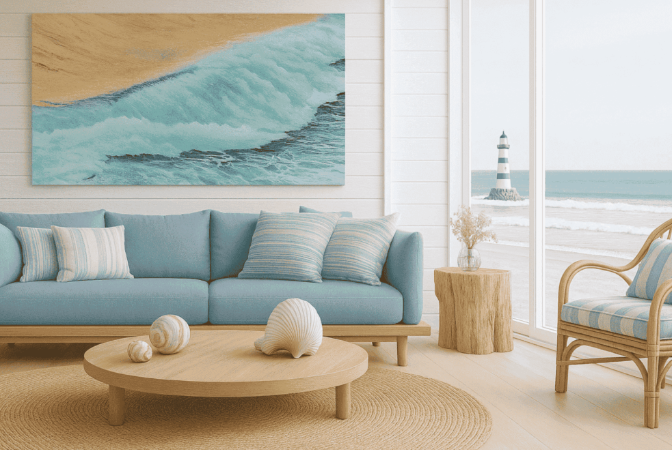
Consider a living room with a low sofa, a timber coffee table, and a large window that faces a neighbouring building rather than an actual landscape. A carefully chosen coastal print can supply the visual distance the window cannot. An image with a long horizon introduces a second line across the room, while a photograph of waves or weathered rock gives the eye something organic to explore. The goal is not to pretend the apartment is beside the ocean. It is to create a visual connection with a place whose scale and movement differ from the compact, controlled geometry of urban life.
Materials around the artwork determine whether that connection feels convincing. A glossy frame, polished chrome accessories, and synthetic surfaces can push a beach photograph toward a showroom effect. A matte frame, woven shade, textured cushion, or simple ceramic vessel creates a more natural transition. These materials need not be rustic. A restrained contemporary room can combine smooth surfaces with one or two tactile elements so the landscape feels integrated rather than decorative. If the artwork contains a dark cliff or stormy sea, repeat one of its tones in a cushion or lamp base; avoid copying every colour in the picture.
Placement is another part of the relationship. Hang coastal art where the eye naturally rests: above a sofa, at the end of a hallway, opposite the entrance to a room, or beside a reading chair. A landscape placed too high can feel disconnected from the furniture beneath it. A print that is too small may look like an afterthought, while one that overwhelms the wall can compete with the room’s architecture. Measure the available width, test paper templates on the wall, and view them from the doorway as well as from the main seat.
For a more restrained interior, choose one image with enough detail to reward attention but enough open space to preserve calm. For a room that feels flat, look for texture in the water, a strong rock formation, or a winding shoreline. The wider coastal art can be approached as a source of landscape and atmosphere rather than as a set of themed accessories. The useful question is not whether the artwork makes the room look like a beach house; it is whether it gives the room a more generous relationship with the natural world.
A home cannot reproduce the weather, sound, or scale of the sea, and it does not need to. Coastal art succeeds when it introduces a small but meaningful reminder that the world is larger and less predictable than the room around us. In a modern interior, that contrast can make clean design feel warmer and more human. The artwork becomes a point of contact between an ordered domestic space and a landscape shaped by wind, water, light, and time.
There is also a useful distinction between bringing nature into a room and decorating with a nature theme. The first leaves the viewer room to respond to the image; the second can become a checklist of expected objects. A photograph of a rocky inlet, for example, can sit beside a sculptural lamp and a favourite chair without needing shells or rope nearby. The image contributes a view, while the other objects keep their own identities. This restraint is especially effective in modern interiors, where the architecture may already be strong. Rather than covering every wall with a landscape, choose one location where the artwork can be seen clearly and let the remaining walls support the room’s light, circulation, and everyday use.
References
Architectural Digest — Coastal Interior Design: Everything You Need to Know